

Course 7: Implementing Research-to-Practice Feedback Loops to Improve Programs Offered to Justice-Involved Individuals
This course is about Implementing Research-to-Practice Feedback Loops to improve programs offered to justice-involved individuals. This course builds on the foundation of material covered over the previous six courses and will advance your skills and expertise in fidelity monitoring processes. As you go through this course, ask yourself how you might use all the fidelity data you’ve gathered to improve programming.
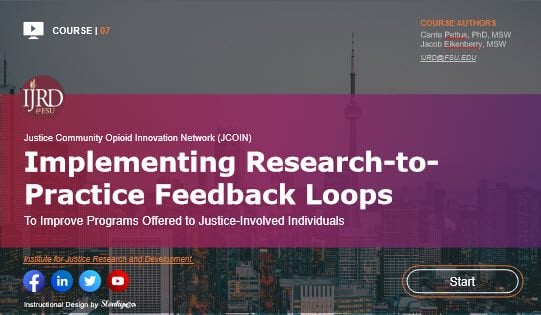




The objectives of this course are to develop in-depth knowledge of the research-to-practice feedback loop, particularly in the context of researcher and practitioner partnerships; to apply feedback-loop skills to simulated scenarios; and to create strategies for implementing the research-to-practice feedback loop for program improvement.
In our first Lesson, we’ll discuss the research to practice feedback loop. In our second lesson, we'll talk about fidelity monitoring's place in the research to practice feedback loop, and in the third lesson will describe strategies for implementing the research to practice feedback loop. Three skill building activities will be interspersed throughout the lessons. The Lessons will conclude with a ten-item posttest, recommended resources for further learning, and finally, a bibliography.
This course is designed to benefit researchers who are interested in conducting experimental and clinical trials of interventions and criminal justice professionals and healthcare professionals who are interested in implementing evidence driven interventions in criminal justice and correctional settings. This series can also benefit healthcare professionals and para-professionals who work with people that have histories of criminal justice system involvement.
This course is sponsored by the Justice Community Opioid Innovation Network (JCOIN), an initiative funded by the National Institute on Drug Abuse (NIDA).
We also gratefully acknowledge the following people or organizations for contributions and support: the Center for Advancing Correctional Excellence at George Mason University, Slonky, LLC, and IJRD team members Amberly Prykhodko, Jennifer Joseph, Shelby Pederson, and Elizabeth Curley for helping to develop the series.
A special thanks to Faye Taxman and Amy Murphy on providing their guidance and input.
Pettus, C. and Eikenberry, J. Implementing Research-to-Practice Feedback Loops to Improve Programming for Programs Offered to Justice-Involved Individuals. (2022). Justice Community Opioid Innovation Network Coordination and Translation Center. https://www.jcoinctc.org/courses/implementing-research-to-practice-feedback-loops-to-improve-programs-offered-to-justice-involved-individuals/
Difficulty level: Beginner/Basic
Completion time: 0.35 hour(s)

Difficulty level: Beginner/Basic
Completion time: 0.75 hour(s)

Difficulty level: Beginner/Basic
Completion time: 0.75 hour(s)
Difficulty level: Beginner/Basic
Completion time: 0.75 hour(s)

Difficulty level: Beginner/Basic
Completion time: 0.75 hour(s)
Difficulty level: Beginner/Basic
Completion time: 0.75 hour(s)

Difficulty level: Beginner/Basic
Completion time: 1.5 hour(s)
Difficulty level: Beginner/Basic
Completion time: 0.75 hour(s)
